
WhatsApp has connected billions of people across the world, but its extraordinary reach has made it one of the most heavily exploited tools in the modern fraudster’s arsenal. The same qualities that make the platform so useful — instant messaging, voice calls, file sharing, broad adoption across every demographic — also make it an attractive vehicle for scammers looking to reach large numbers of potential victims quickly and at virtually no cost. In India alone, millions of WhatsApp accounts are suspended every month due to fraudulent activity, and yet the schemes continue to evolve and adapt faster than platform-level enforcement can eliminate them.
The consequences for victims are serious. Financial losses from WhatsApp-based fraud range from a few thousand rupees lost to a convincing job offer scam to millions transferred in a sophisticated investment fraud that builds over weeks or months. Personal data stolen through phishing links can lead to account takeovers, identity theft, and cascading financial damage that takes years to fully resolve. Understanding how these scams are constructed and what warning signs they share is one of the most practical steps any WhatsApp user can take to protect themselves.
Responsible digital platforms across industries recognize the threat that fraud poses to their users and invest accordingly in security infrastructure. Platforms like reputable online betting platforms implement identity verification systems, secure account protocols, and active monitoring to protect users from impersonation and fraudulent activity — a standard of care that reflects the broader responsibility digital services carry when handling user communications and financial transactions. This guide covers the most common WhatsApp fraud techniques currently in use, how to recognize them before they cause harm, and what steps to take if you or someone you know has already been targeted.
How WhatsApp Scams Are Structured and Why They Work
The foundation of virtually every WhatsApp scam is deception about identity. A fraudster contacts you pretending to be someone or something you have reason to trust — a family member with a new phone number, a bank representative calling about suspicious activity on your account, a customer support agent from a platform you use, or a government official with an urgent matter requiring your immediate cooperation. The impersonation is the entry point, and everything that follows is designed to exploit the trust that identity creates.
What makes modern WhatsApp scams significantly more dangerous than their predecessors is the level of effort that goes into making them convincing. Scam messages in 2026 are frequently well-written, contextually plausible, and sometimes accompanied by genuine-looking documents, profile photos copied from real accounts, and references to personal details gathered from social media. The days when a scam message could be identified at a glance by its poor grammar and obviously implausible premise have not entirely passed, but they are increasingly the exception rather than the rule.
The psychological mechanisms that scammers exploit are consistent across most fraud types: urgency, authority, and fear. A message that creates time pressure — your account will be blocked in 24 hours, your relative needs money urgently before a hospital will treat them, a package will be returned to sender if you do not click this link immediately — is attempting to prevent you from pausing long enough to think critically about whether the situation is genuine. Recognizing this pattern of manufactured urgency is one of the most reliable ways to identify a scam before it causes damage.
The Most Common WhatsApp Fraud Techniques
Impersonation scams targeting family members are among the most emotionally effective WhatsApp fraud techniques and account for a significant volume of financial losses. The setup is typically simple: a message arrives from an unknown number claiming to belong to a relative who has lost or broken their phone and needs urgent financial help — a medical expense, a bail payment, a transfer to cover an emergency until they can access their own account. The request feels plausible because the emotional stakes are high and the verifiable details are deliberately vague. The correct response to any such message is to contact the person it claims to be from directly through their known number or in person before taking any action.
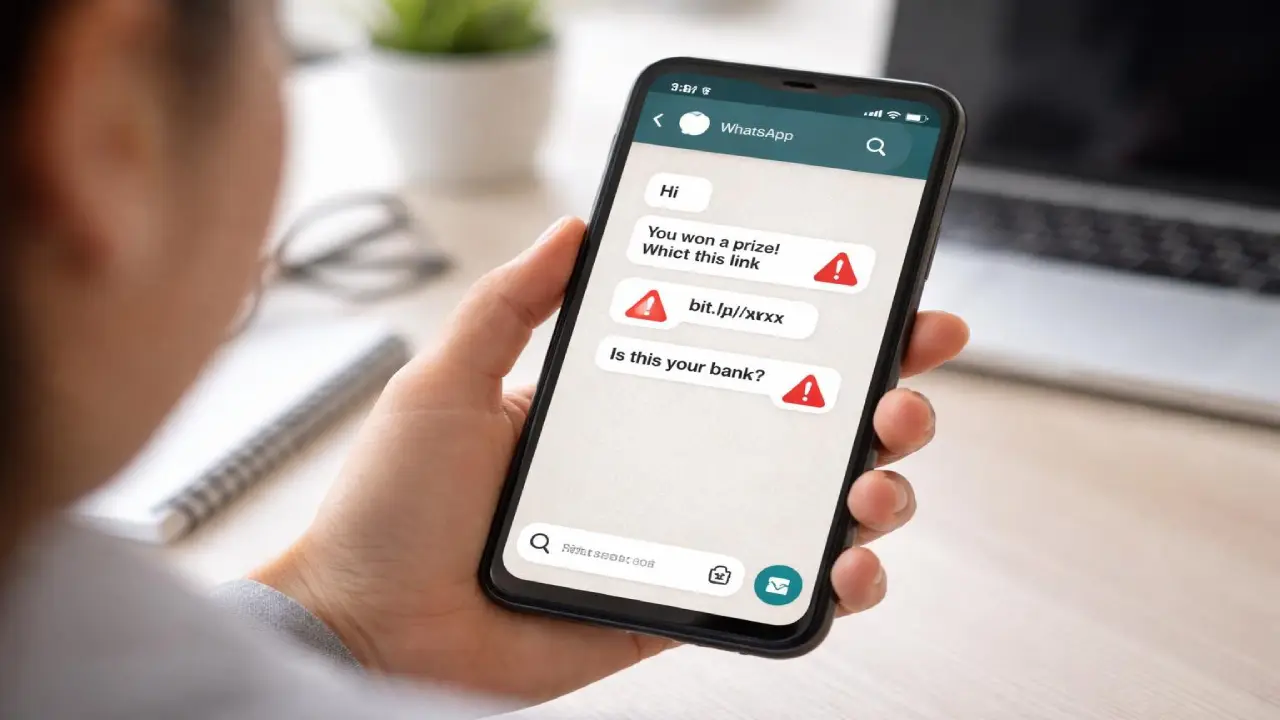
Phishing links represent the most technically dangerous category of WhatsApp fraud. These messages deliver a link that appears to come from a legitimate source — a courier company notifying you of a missed delivery, a bank alerting you to suspicious account activity, a retailer offering a time-limited discount — but the destination is a fraudulent website designed to capture your login credentials, payment details, or personal information. In some cases, simply visiting the linked page can install malware on your device without any further interaction required. Any link received through WhatsApp from an unverified contact should be treated with extreme caution, particularly if the message creating urgency around clicking it.
Fake prize and lottery scams operate on a straightforward but consistently effective premise: you are informed that you have won a significant sum of money or a valuable prize through a WhatsApp draw or promotion. To claim your winnings, you are asked to pay a processing fee, provide personal documentation, or scan a QR code that will facilitate the transfer. The processing fee is never returned, and the prize does not exist. QR codes in these scams are particularly dangerous because scanning them can grant the scammer direct access to your payment applications or bank accounts without requiring any additional steps from you.
Business impersonation fraud has grown significantly alongside the broader adoption of WhatsApp for commercial communication. Scammers create fake business accounts that mimic legitimate companies — copying logos, business names, and customer service messaging styles — to solicit advance payments for products that will never arrive, capture payment details through fraudulent checkout links, or conduct fake recruitment processes that ultimately request personal documentation or registration fees from applicants. Any business contact on WhatsApp that requests payment or sensitive information should be verified through the company’s official website or publicly listed contact details before any action is taken.
Technical Fraud Methods: SIM Swapping and Account Takeover
Beyond social engineering, some WhatsApp fraud involves more technically sophisticated methods of gaining unauthorized access to a victim’s account or phone number. SIM swapping occurs when a scammer convinces a mobile network operator to transfer your phone number to a SIM card under their control, typically by impersonating you to the carrier using personal details gathered from data breaches or social media. Once they control your number, they can intercept WhatsApp verification codes, take over your account, and access any other services that use SMS-based authentication. The most common warning sign of a SIM swap in progress is a sudden and unexplained loss of mobile network service — if your phone loses signal with no obvious cause, contacting your carrier immediately should be a priority.
Account takeover through QR code linking is a simpler but equally effective method. WhatsApp’s feature that allows accounts to be linked to additional devices uses a QR code scan to authenticate the connection. Scammers who can convince a victim to scan a QR code — typically by framing it as a verification step for a prize, a customer support process, or an account security update — can link the victim’s WhatsApp account to a device they control. From that point, they have full visibility of messages and contacts and can impersonate the victim to everyone in their contact list. WhatsApp will never ask you to scan a QR code through a message from an unknown contact, and any such request should be rejected and reported immediately.
Recognizing the Warning Signs Before It Is Too Late
The warning signs of a WhatsApp scam are identifiable once you know what to look for, and developing the habit of checking for them before responding to any unexpected message is one of the most effective protective measures available. An unknown number claiming to be someone you know is an immediate prompt to verify through a separate channel before engaging further. A message that creates time pressure — using phrases like “act now,” “within the next hour,” or “your account will be suspended” — is attempting to override your critical thinking and should instead trigger additional scrutiny rather than immediate compliance.
Requests for any of the following should be treated as automatic red flags regardless of how convincing the surrounding message appears: banking details, passwords, one-time password codes, QR code scans, advance payments for prizes or job offers, or personal identity documents sent through chat. Legitimate banks, government agencies, employers, and reputable platforms never request this information through WhatsApp. Profile accounts with no visible photo, very recent creation dates, or generic usernames that do not match the identity being claimed are also reliable indicators of fraudulent intent.
Protecting Your WhatsApp Account Proactively
The most important single security step any WhatsApp user can take is enabling two-step verification, which requires a six-digit PIN in addition to the standard SMS verification code when registering your number on a new device. This means that even if a scammer intercepts your verification code through a SIM swap or other method, they cannot access your account without also knowing the PIN you set. Two-step verification is available in WhatsApp settings under Account and takes less than two minutes to set up.
Adjusting your privacy settings to limit who can see your profile photo, last seen status, and personal information to contacts only reduces the amount of data available to scammers who may be profiling you before making contact. Restricting who can add you to group chats — a common method used to add targets to scam operations at scale — provides additional protection against unsolicited exposure to fraud schemes.
Discussing these threats with older family members is particularly valuable, as seniors are disproportionately targeted by family emergency impersonation scams and are sometimes less familiar with the patterns that identify a fraudulent message. A simple family protocol — always call to verify before sending money, never share OTP codes with anyone, be skeptical of new numbers claiming to belong to known contacts — can prevent significant financial harm.
What to Do If You Have Already Been Targeted
If you have fallen victim to a WhatsApp scam, the speed of your response has a direct impact on the extent of the damage that can be limited. If money has been transferred, contact your bank immediately — banks can sometimes freeze accounts involved in fraudulent transactions if notified quickly enough, and early action gives you the best chance of recovering funds. File a formal complaint through your country’s cybercrime reporting portal and provide as much evidence as possible, including screenshots of the conversation, phone numbers used by the scammer, and records of any transactions that occurred.
If your WhatsApp account has been taken over, re-registering your phone number on the platform will log out any unauthorized devices. If the scammer has enabled two-step verification on your account to prevent you from recovering it, WhatsApp support provides an account recovery process, though it requires patience and persistence to navigate. Notify your contacts as quickly as possible through another channel that your account was compromised, so they can disregard any messages the scammer may have sent while in control of it.
The Evolving Threat Landscape
WhatsApp fraud is not static — it evolves continuously in response to user awareness campaigns, platform security improvements, and law enforcement action. Artificial intelligence is beginning to play a role in how scammers operate, enabling more convincing message generation, voice cloning that can mimic the speech patterns of real people in audio messages, and deepfake video content that makes impersonation more credible than ever. Multi-platform fraud operations that coordinate activity across WhatsApp, Telegram, Instagram, and other social media channels simultaneously are becoming more common, making it harder to trace the origin of a scheme and easier for fraudsters to create an illusion of legitimacy through apparent cross-platform presence.
Investment and cryptocurrency scams involving WhatsApp are projected to increase significantly in the coming years as more users become interested in digital assets and scammers move quickly to exploit that interest with fake trading platforms, fraudulent investment groups, and impersonation of legitimate financial services. Staying informed about the current state of WhatsApp fraud — and sharing that awareness with the people around you — remains one of the most effective defenses against a threat that will continue to adapt.