

Blackjack stands as one of the most popular card games in casinos worldwide, combining skill and chance in a way that attracts millions of players. Also known as “21,” this classic game pits players against the dealer in a race to get as close to 21 points as possible without going over.
The goal of blackjack is simple: beat the dealer by having a hand value closer to 21 than theirs, or by making the dealer bust by going over 21. Unlike many casino games that rely purely on luck, blackjack allows players to use strategy to improve their odds of winning.
Understanding the rules, strategies, and variations of blackjack can transform a casual player into someone who knows how to make smart decisions at the table. From basic gameplay mechanics to advanced techniques, mastering blackjack involves learning about odds, proper etiquette, and how to avoid common mistakes that cost players money.

What Is Blackjack?
Blackjack is a casino card game where players try to get cards that add up to 21 without going over. The game comes from old European card games and has simple rules that make it easy to learn.
Origins of Blackjack
Blackjack started from a family of card games called “twenty-one.” These games were played in Europe for hundreds of years. The French played a game called “vingt-et-un” which means twenty-one in French.
The game came to America in the 1700s. Casino owners wanted more players to try the game. They offered special payouts for certain hands.
One popular bonus paid extra money if a player got the ace of spades and a black jack. This is where the name “blackjack” comes from. The bonus rule is gone now, but the name stayed.
Different names for similar games:
- Vingt-et-un (French)
- Pontoon (British)
- Twenty-one (General term)
How the Game Is Played
Players sit at a table with a dealer. Each player gets two cards face up. The dealer gets two cards with one face down.
Cards have these values:
- Number cards (2-10): Face value
- Face cards (Jack, Queen, King): 10 points each
- Ace: 1 point or 11 points
Players look at their cards and decide what to do. They can ask for more cards or keep what they have. If their cards add up to more than 21, they lose right away.
The dealer plays last. The dealer must take cards if their total is 16 or less. The dealer must stop if their total is 17 or more.
Objective of Blackjack
The goal is to beat the dealer without going over 21. Players win in three ways: get closer to 21 than the dealer, get exactly 21, or have the dealer go over 21.
A “natural blackjack” is the best hand. This happens when a player gets 21 with just two cards – an ace and a 10-point card. This hand usually pays more money than regular wins.
Players compete only against the dealer, not each other. Each player makes their own choices and wins or loses based on their hand compared to the dealer’s hand.
Going over 21 is called “busting.” Any player who busts loses immediately, even if the dealer also busts later.

Blackjack Rules and Gameplay
Blackjack follows straightforward rules where players compete against the dealer to reach 21 points without going over. The game uses standard card values, follows a structured turn-based format, and requires the dealer to hit or stand based on specific requirements.
Card Values and Scoring
Each card in blackjack has a specific point value that determines hand totals. Number cards from 2 through 10 are worth their face value.
Face cards (Jack, Queen, King) each count as 10 points. Aces are flexible and count as either 1 or 11 points, whichever makes the better hand.
When an Ace counts as 11, the hand is called “soft.” If counting the Ace as 11 would make the hand go over 21, it automatically becomes worth 1 point instead.
| Card Type | Point Value |
|---|---|
| 2-10 | Face value |
| Jack, Queen, King | 10 points |
| Ace | 1 or 11 points |
The goal is to get as close to 21 points as possible without exceeding it. Going over 21 is called “busting” and results in an automatic loss.
Gameplay Structure
Each round begins with players placing their bets before any cards are dealt. The dealer then gives each player two cards face up and deals themselves one card face up and one face down.
Players act first, starting from the dealer’s left. Each player can hit (take another card), stand (keep current total), double down (double bet and take one card), or split (separate pairs into two hands).
If a player’s first two cards total 21 (an Ace and a 10-value card), this is called “blackjack” and typically pays 3 to 2 odds.
Players must decide their actions before the dealer plays. Once all players finish, the dealer reveals their hidden card and completes their hand according to house rules.
Dealer Rules
The dealer must follow strict rules that remove any decision-making from their play. These rules are the same at most casinos and cannot be changed during the game.
The dealer must hit on any hand totaling 16 or less. The dealer must stand on any hand totaling 17 or more.
Some casinos require dealers to hit on “soft 17” (a hand with an Ace counting as 11, like Ace-6). Other casinos require dealers to stand on all 17s.
The dealer has no choice in these actions. They cannot hit on 17 or stand on 16, regardless of what players have. If the dealer busts by going over 21, all remaining players win automatically.
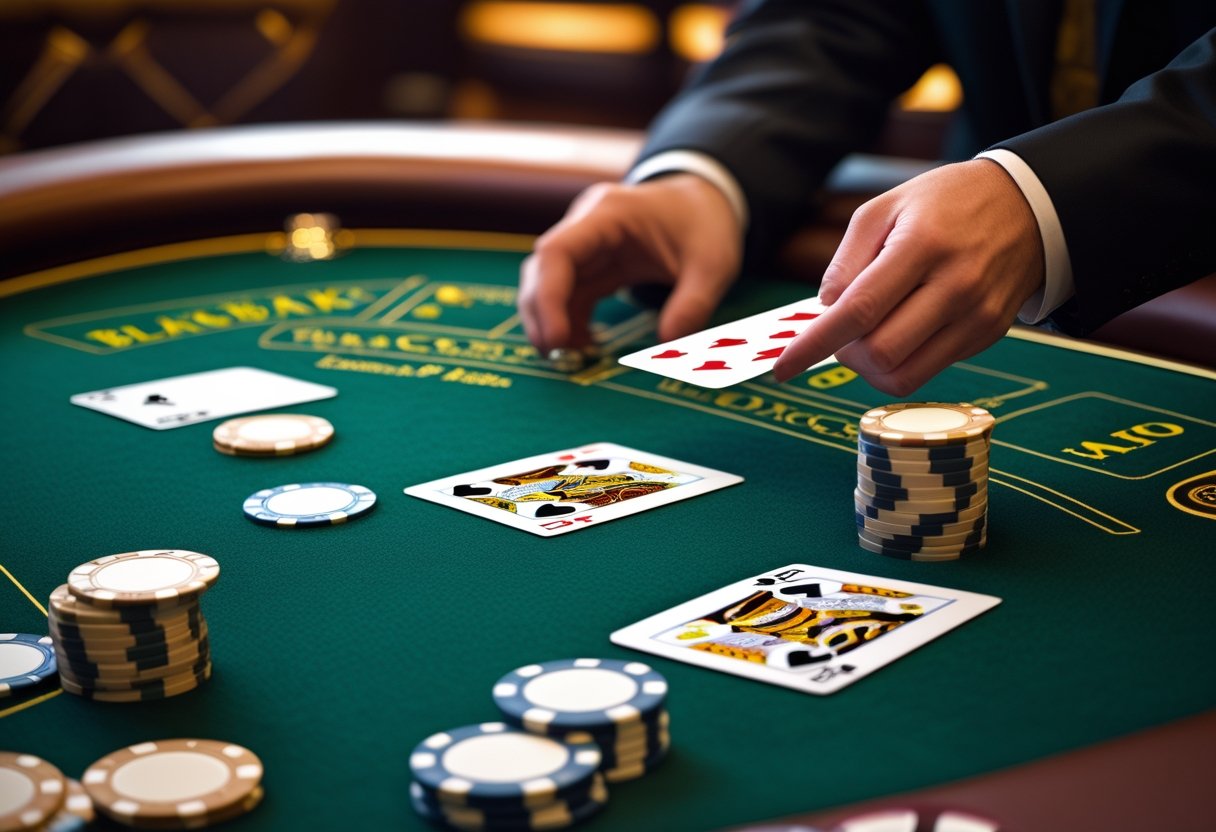
Blackjack Table Setup
A proper blackjack table setup requires specific layout elements and seating arrangements. The table follows standard casino dimensions and player positioning rules.
Table Layout
A standard blackjack table measures 7 feet long by 3.5 feet wide. The table features a semicircular shape with the dealer positioned on the straight side.
The playing surface includes several key areas:
- Betting circles: Seven circular spots where players place chips
- Dealer area: Space for the shoe, discard tray, and chip rack
- Insurance line: Semicircular line for insurance bets
- Blackjack payout notation: Usually marked as “3 to 2”
The table uses green felt covering in most casinos. Home setups can use any suitable fabric or specialized gaming cloth.
Essential equipment includes:
- Card shoe (holds 6-8 decks)
- Discard tray
- Dealer chip rack
- Cut card (plastic card to mark shuffle point)
The dealer position features a small notch or designated area. This spot holds the chip rack on the dealer’s right side and discard tray on the left.
Seating and Player Positions
Blackjack tables accommodate up to seven players. Each position has a numbered betting circle from first base to third base.
First base sits immediately to the dealer’s left. This player receives cards first and acts first on each hand.
Third base occupies the dealer’s far right. This position acts last before the dealer plays their hand.
Players can sit at any open position. No specific seating order is required beyond the numbered spots.
Each player needs:
- Clear access to their betting circle
- Space for cards (about 12 inches)
- Room for chip stacks
- View of dealer’s up card
Standing players cannot participate in most casino games. Home games may allow standing but should maintain clear betting positions.
Popular Blackjack Variations
Different blackjack games have unique rules that change how players win and lose. European Blackjack uses two decks and limits dealer actions, while American Blackjack allows hole cards and early peeks. Spanish 21 removes all 10-value cards but adds bonus payouts.
European Blackjack
European Blackjack uses two standard decks of cards. The dealer receives only one face-up card at the start of each hand.
Players must make all decisions before the dealer draws their second card. This rule prevents players from knowing if the dealer has blackjack early.
Key Rules:
- Dealer stands on soft 17
- Double down only on 9, 10, or 11
- Split only once per hand
- No surrender option
The house edge stays around 0.62% with basic strategy. Players cannot double after splitting cards.
Insurance bets are available when the dealer shows an ace. The payout remains 2:1 for insurance wins.
American Blackjack
American Blackjack deals the dealer two cards from the start. One card faces up and one faces down (hole card).
The dealer checks for blackjack immediately when showing an ace or 10-value card. This peek rule helps players avoid losing extra money on splits and doubles.
Main Features:
- Uses 6-8 decks typically
- Surrender allowed at most casinos
- Double after split permitted
- Dealer hits soft 17
Players can double down on any two cards. Most casinos allow splitting up to three times.
The house edge ranges from 0.28% to 0.60% depending on specific rules. Late surrender reduces the house edge by about 0.08%.
Spanish 21
Spanish 21 removes all four 10s from each deck while keeping jacks, queens, and kings. This creates a 48-card deck instead of 52.
Players get special bonus payouts that regular blackjack does not offer. A 21 made with five cards pays 3:2. Six cards totaling 21 pays 2:1.
Bonus Payouts:
- 7-7-7 (same suit): 50:1
- 6-7-8 (mixed suits): 3:2
- 6-7-8 (same suit): 2:1
- 6-7-8 (spades): 3:1
Player 21 always beats dealer 21. Players can double after any number of cards.
Late surrender is allowed after doubling. The house edge is approximately 0.76% with optimal play despite the missing 10s.
Basic Strategy for Blackjack
Basic strategy tells players the mathematically correct decision for every possible hand combination. It reduces the house edge to about 0.5% when followed precisely.
Strategy Charts
A basic strategy chart shows the optimal play for every player hand against each dealer upcard. The chart uses colors to represent different actions: hit, stand, double down, split, or surrender.
Players should memorize these charts or keep them nearby during play. Each chart varies slightly based on specific game rules like number of decks and dealer actions.
Hard hands (no ace or ace counted as 1) follow different rules than soft hands (ace counted as 11). The dealer’s upcard determines which action gives the best mathematical outcome.
Most charts display player hands on the left side and dealer upcards across the top. The intersection shows the correct play for that combination.
When to Hit or Stand
The decision to hit or stand depends on the player’s total and the dealer’s visible card. Players should stand on hard 17 or higher in almost all situations.
Hit when:
- Hard totals of 11 or less (impossible to bust)
- Hard 12 against dealer 2 or 3
- Hard 13-16 against dealer 7 or higher
Stand when:
- Hard 17 or higher
- Hard 13-16 against dealer 2-6
- Soft 18 against dealer 2-8
The dealer must hit on 16 and stand on 17. This rule creates opportunities for players to let weak dealer hands bust naturally.
Doubling Down
Doubling down allows players to double their bet and receive exactly one more card. This option works best when the player has a strong chance of winning with one additional card.
Double down on:
- Hard 11 against any dealer card except ace
- Hard 10 against dealer 2-9
- Hard 9 against dealer 3-6
- Soft 16-18 against dealer 2-6
Players cannot double down after splitting in most casinos. The single card restriction means players must accept whatever card they receive.
Soft doubling targets situations where the ace provides flexibility. Even a low card keeps the hand competitive.
Splitting Pairs
Splitting pairs creates two separate hands from identical cards. Players must place an equal bet on the second hand and play each hand independently.
Always split:
- Aces (creates two chances for blackjack)
- 8s (avoids the weak total of 16)
Never split:
- 10s or face cards (20 is too strong to break up)
- 5s (total of 10 is perfect for doubling)
Split based on dealer upcard:
- 2s, 3s, 6s, 7s, 9s against specific dealer totals
- Follow the strategy chart for exact situations
Some casinos limit actions after splitting aces. Players typically receive only one card per ace and cannot double down.
Advanced Blackjack Strategies
Card counting systems help players track high and low cards to gain an advantage over the house. Shuffle tracking involves following card groups through shuffles, while proper bet sizing maximizes profits during favorable counts.
Card Counting Methods
The Hi-Lo system is the most popular card counting method for beginners. Players assign values to cards: +1 for cards 2-6, 0 for cards 7-9, and -1 for cards 10-Ace.
A positive count means more low cards have been played. This leaves more high cards in the deck, which favors the player. A negative count indicates more high cards have been dealt.
Players convert the running count to a true count by dividing by the number of decks remaining. This gives a more accurate picture of the deck composition.
The KO system eliminates true count conversion by using an unbalanced count. Players start at -4 with a single deck and adjust for multiple decks. This system is easier but slightly less accurate than Hi-Lo.
Advanced counting systems like Hi-Opt II or Omega II track more card values. These methods provide better accuracy but require more practice and mental effort during play.
Shuffle Tracking
Shuffle tracking involves following groups of cards through the shuffle process. Players identify slugs of high or low cards and track where they end up in the new shoe.
This technique works best with predictable shuffle patterns. Players must observe how dealers cut and shuffle cards consistently. Casino shuffles often follow specific procedures that skilled players can exploit.
Zone tracking focuses on larger sections rather than specific card groups. Players estimate which zones contain favorable cards and adjust their betting accordingly.
The method requires excellent visual memory and pattern recognition. Players must practice identifying card positions without appearing obvious to casino staff.
Shuffle tracking works best when combined with card counting. The two techniques together can provide significant advantages over basic strategy alone.
Bet Sizing Techniques
Kelly Criterion determines optimal bet sizes based on bankroll and advantage. Players bet a percentage equal to their edge divided by the variance. This maximizes long-term growth while minimizing risk of ruin.
Flat betting uses the same bet size regardless of count. This approach reduces variance but doesn’t capitalize on favorable situations. It works well for players who want steady, conservative play.
Progressive betting systems increase bets after wins and decrease after losses. The 1-3-2-6 system and Paroli method are popular choices. These systems don’t change house edge but can maximize winning streaks.
True count betting adjusts wager size based on the advantage. Players typically bet one unit per true count point above zero. A true count of +3 would warrant a 3-unit bet.
Proper bankroll management requires at least 100 betting units for casual play. Serious advantage players need 500-1000 units to handle normal fluctuations without going broke.
House Edge and Odds in Blackjack
The house edge in blackjack typically ranges from 0.28% to 2%, making it one of the best casino games for players. Game rules, payout structures, and player strategy directly impact these odds and determine how much advantage the casino holds.
Influence of Rules on Odds
Different blackjack rules change the house edge by varying amounts. The dealer’s action on soft 17 affects odds significantly.
When dealers stand on soft 17, the house edge drops by about 0.2% compared to hitting soft 17. This single rule change makes a noticeable difference in player odds.
Doubling down rules also impact the house edge:
- Doubling on any two cards: reduces house edge by 0.25%
- Doubling only on 10 or 11: increases house edge by 0.26%
- Doubling after splitting: reduces house edge by 0.13%
Surrender options benefit players when available. Early surrender reduces the house edge by 0.24%, while late surrender reduces it by 0.08%.
The number of decks used changes odds too. Single deck games typically offer a 0.17% lower house edge than eight-deck games.
Payout Structures
Blackjack payouts directly affect the house edge and player returns. The standard 3:2 payout for blackjack keeps the house edge low.
Standard payout comparison:
- 3:2 blackjack payout: baseline house edge
- 6:5 blackjack payout: increases house edge by 1.39%
- Even money blackjack: increases house edge by 2.27%
Many casinos now offer 6:5 payouts instead of 3:2, especially on lower limit tables. This change alone makes the game much worse for players.
Insurance bets carry a high house edge of about 7.4% in single deck games and 7.7% in multi-deck games. Players should avoid insurance bets in almost all situations.
Side bets typically have house edges ranging from 2% to 25%, making them poor value compared to the main game.
Reducing the House Edge
Basic strategy reduces the house edge to its minimum possible level for any given set of rules. Perfect basic strategy can lower the house edge to under 0.5% in favorable games.
Key strategy elements that reduce house edge:
- Hit or stand decisions based on dealer upcard
- Doubling down on favorable hands like 11 against dealer 6
- Splitting pairs when mathematically advantageous
- Never taking insurance bets
Card counting can give skilled players a slight edge over the house. However, casinos actively work to prevent card counting through shuffling machines and surveillance.
Choosing games with favorable rules makes a bigger difference than most players realize. A game with dealer stands on soft 17, 3:2 blackjack payouts, and liberal doubling rules can have a house edge under 0.3%.
Players should avoid side bets and focus on basic strategy to minimize the house advantage.
Common Blackjack Mistakes
Many players lose money at blackjack tables because they make basic errors. These mistakes include not knowing how to count card values, missing important table rules, and betting more money after losing hands.
Misunderstanding Hand Values
New players often struggle with counting card values correctly. Aces can be worth 1 or 11 points, which confuses many people.
Face cards (Jack, Queen, King) are always worth 10 points. Number cards from 2 through 10 keep their face value.
Soft hands contain an Ace counted as 11. A soft 17 means Ace-6, where the Ace equals 11 points. Hard hands either have no Ace or count the Ace as 1 point.
Players make costly mistakes when they forget these rules:
- Counting Aces as only 1 or only 11
- Thinking face cards have different values
- Not knowing when a hand becomes “hard”
The dealer’s up card matters for strategy decisions. Players who cannot quickly calculate hand values will make wrong choices about hitting or standing.
Ignoring Table Rules
Each blackjack table has specific rules that affect the game. Players who ignore these rules miss chances to win or make bad bets.
Dealer rules vary between tables. Some dealers hit on soft 17, while others stand. This changes the house edge by about 0.2%.
Doubling down rules differ too. Some tables allow doubling on any two cards. Others only allow it on totals of 9, 10, or 11.
Split rules also change:
- Number of times you can split
- Whether you can split Aces
- If you can double after splitting
Surrender options let players give up half their bet on bad hands. Not all tables offer this choice.
Side bets like insurance usually favor the house. Smart players avoid these extra wagers.
Chasing Losses
Players often make bigger bets after losing hands to try winning back money quickly. This approach leads to larger losses.
Progressive betting systems like the Martingale seem attractive but are dangerous. These systems require doubling bets after losses. A losing streak can quickly drain a bankroll.
Smart players set loss limits before they start playing. They walk away when they reach this amount. Emotional betting decisions usually end badly.
Card counting does not work in short sessions. Players cannot overcome bad luck by betting more money on single hands.
Bankroll management means betting only 1-5% of total gambling money per hand. This helps players survive losing streaks without going broke.
Alcohol affects judgment at the table. Players make worse decisions and chase losses more often when drinking.
Playing Blackjack Online
Online blackjack offers players access to live dealers, mobile gaming, and games from top software companies. Players can choose from real-time streamed games with human dealers or digital versions optimized for smartphones and tablets.
Live Dealer Blackjack
Live dealer blackjack streams real games from studios or casinos directly to players’ screens. Professional dealers shuffle physical cards and interact with players through chat functions.
Players see everything happen in real-time through high-definition cameras. Multiple camera angles show the dealer, cards, and betting table clearly.
Popular live dealer features include:
- Real-time chat with dealers
- Multiple betting positions at one table
- Side bets like Perfect Pairs
- Various table limits from $1 to $500+
Games run 24/7 with dealers working in shifts. Players join tables instantly without waiting for specific game times.
Live blackjack uses the same rules as traditional casino games. Cards are dealt from physical shoes containing multiple decks.
Mobile Blackjack Apps
Mobile blackjack apps let players access games on smartphones and tablets. Most casino apps work on both iOS and Android devices.
Key mobile features include:
- Touch screen controls for hitting, standing, and betting
- Optimized graphics for smaller screens
- Quick loading times
- Offline practice modes
Players download apps directly from casino websites or app stores. Many casinos also offer browser-based mobile games that don’t require downloads.
Mobile games include the same betting options and rules as desktop versions. Players can deposit money, claim bonuses, and withdraw winnings through mobile apps.
Battery usage stays reasonable during typical gaming sessions. Most apps include settings to reduce data usage on cellular connections.
Software Providers
Software companies create the digital blackjack games that online casinos offer. Each provider brings different features and game styles.
Major blackjack software providers:
- NetEnt – Known for smooth graphics and standard rules
- Evolution Gaming – Specializes in live dealer games
- Microgaming – Offers classic blackjack variations
- Playtech – Provides multiple betting options
Different providers use varying numbers of decks and rule sets. Some allow doubling after splitting while others restrict this option.
Graphics quality and game speed differ between software companies. Players often develop preferences for specific providers based on interface design and gameplay feel.
Most online casinos partner with multiple software providers. This gives players access to different blackjack styles and features within one casino account.
Blackjack Etiquette and Best Practices
Good blackjack etiquette helps create a smooth game for everyone at the table. Players should know the proper ways to handle cards and chips while showing respect to dealers and other players.
Table Manners
Joining a Game Players should wait for the current hand to finish before sitting down. Never interrupt a game in progress by asking questions or trying to buy chips.
Communication with the Dealer Keep conversations brief and polite. Dealers need to focus on the game. Wait for appropriate moments to ask questions about rules or betting limits.
Respecting Other Players Avoid giving unsolicited advice to other players about their hands. Each player makes their own decisions. Don’t comment on someone’s playing strategy or results.
Phone and Device Usage Keep phones away from the table during play. Many casinos prohibit phone use at blackjack tables. Turn off ringers to avoid disrupting the game.
Tipping Guidelines Tip dealers when winning or leaving the table. A common practice is tipping 5-10% of winnings or placing a bet for the dealer. Cash tips work too.
Handling Chips and Cards
Placing Bets Put chips in the betting circle before cards are dealt. Stack chips with highest values on bottom. Don’t touch your bet once cards start being dealt.
Card Handling Rules In handheld games, pick up cards with one hand only. Keep cards above the table at all times. Never bend or mark the cards.
Hand Signals Use proper hand signals instead of verbal commands. Hit: tap the table. Stand: wave hand horizontally. Double down: place additional chips next to original bet and hold up one finger.
Chip Organization Keep chips stacked neatly in front of you. Don’t splash chips around or hide large denominations behind smaller ones. This helps dealers and other players see your chip count clearly.
Responsible Gambling in Blackjack
Playing blackjack safely requires setting clear money limits before starting and managing funds carefully. These practices help players avoid spending more than they can afford while keeping the game fun.
Setting Betting Limits
Players should decide on maximum betting amounts before sitting at any blackjack table. This includes setting daily, weekly, and monthly spending limits.
Daily limits work best for casual players. They might set $50 as their maximum loss for one gaming session. Once they reach this amount, they stop playing for the day.
Weekly limits help regular players control spending over longer periods. A player might choose $200 as their weekly limit across all blackjack sessions.
Many online casinos offer built-in limit tools. Players can set these limits in their account settings. The casino will automatically stop them from betting once they reach their chosen amount.
Important limit guidelines:
- Set limits when not gambling
- Choose amounts that won’t hurt finances
- Never increase limits during play
- Stick to limits even when winning
Managing Your Bankroll
Bankroll management means dividing gambling money into smaller portions for each game session. This prevents players from losing everything in one bad session.
The 5% rule works well for most players. They should never bet more than 5% of their total gambling budget on a single hand. If someone has $100 for blackjack, their maximum bet per hand should be $5.
Players should separate their gambling money from other funds. They can use a different bank account or prepaid card just for blackjack. This prevents accidentally spending money meant for bills or groceries.
Key bankroll tips:
- Never gamble with borrowed money
- Don’t chase losses with bigger bets
- Set win goals and stop when reached
- Track all wins and losses
Smart players also take breaks every 30-60 minutes during play. This helps them make better decisions and avoid emotional betting.
Blackjack Tournaments
Blackjack tournaments offer players a chance to compete against each other rather than just the house, using set bankrolls and limited hands to determine winners. Success requires mastering both basic blackjack strategy and specific tournament tactics like chip management and positional play.
Tournament Formats
Most blackjack tournaments follow a structured format where players start with identical chip amounts. Common formats include elimination rounds where the lowest chip counts get removed after set numbers of hands.
Single-table tournaments typically seat 6-7 players who play a predetermined number of hands. The player with the most chips at the end wins the table.
Multi-table events start with many tables and advance winners to subsequent rounds. These tournaments can last several days and offer larger prize pools.
Sit-and-go tournaments begin as soon as enough players register. They offer quick action and immediate results for players who want shorter sessions.
Scheduled tournaments have set start times and registration periods. These events often feature guaranteed prize pools and attract more serious competitors.
Players receive tournament chips that cannot be exchanged for cash during play. Only final standings determine prize distribution.
Strategies for Winning Tournaments
Tournament play requires different strategies than regular blackjack. Chip management becomes crucial since players must finish with more chips than opponents, not just beat the dealer.
Positional awareness helps players make strategic decisions. Acting last provides advantages since players can see opponents’ moves before deciding their own actions.
Players should vary bet sizes based on their chip position relative to others. Leaders often make smaller, safer bets while trailing players need aggressive betting to catch up.
All-in moments require careful timing. Players trailing near the end may need to risk everything on favorable hands to have winning chances.
Basic strategy knowledge remains essential. Players cannot succeed with tournament tactics alone if they make poor fundamental blackjack decisions.
Watching opponents’ chip counts and betting patterns provides valuable information for making strategic adjustments throughout the tournament.
Blackjack in Popular Culture
Blackjack has become a cultural symbol that appears in movies, books, and stories about famous players. The game represents risk, strategy, and the tension between luck and skill in popular entertainment.
Famous Blackjack Players
Several players have gained fame for their blackjack skills and strategies. Edward Thorp wrote the book “Beat the Dealer” in 1962, which introduced card counting to the public.
Ken Uston became well-known in the 1970s and 1980s for leading blackjack teams. He wrote several books about his experiences and appeared on television shows.
The MIT Blackjack Team gained widespread attention in the 1990s. This group of college students used card counting and teamwork to win millions from casinos.
Don Johnson made headlines in 2011 when he won over $15 million from Atlantic City casinos. He used legal advantage play techniques and negotiated favorable rules.
These players became famous because they showed that skill could beat the house. Their stories inspired books, movies, and documentaries about beating casinos.
Blackjack in Movies and Literature
Hollywood has featured blackjack in many films. “21” (2008) told the story of the MIT Blackjack Team and brought card counting to mainstream audiences.
“Rain Man” (1988) showed an autistic character counting cards in Las Vegas. The movie helped make blackjack counting famous in popular culture.
Classic films like “Casino” (1995) and “Ocean’s Eleven” series include blackjack scenes that show the game’s connection to gambling culture.
Books about blackjack include both fiction and non-fiction works. “Bringing Down the House” by Ben Mezrich inspired the movie “21.”
The game often represents themes of risk and reward in stories. Writers use blackjack to show characters facing difficult choices and testing their luck.
Frequently Asked Questions
New and experienced players often have questions about blackjack rules, gameplay mechanics, and winning strategies. Understanding the basic game structure, legal online play options, and differences between casino formats helps players make informed decisions at the table.
How does one play Blackjack 21?
Players receive two cards and add their values together. Face cards count as 10, aces count as 1 or 11, and number cards equal their face value.
The goal is to get as close to 21 as possible without going over. Players can hit to take another card or stand to keep their current total.
If a player’s cards exceed 21, they bust and lose immediately. The dealer follows specific rules and must hit on 16 or less and stand on 17 or more.
What are the basic rules of blackjack?
Each player competes against the dealer, not other players. Players win by having a higher total than the dealer without exceeding 21.
Blackjack pays 3 to 2 when a player’s first two cards total 21. Regular wins pay 1 to 1, or even money.
Players can double down on their first two cards, doubling their bet and receiving exactly one more card. They can also split pairs into two separate hands with equal bets.
Are there any strategies to improve winning chances in blackjack?
Basic strategy tells players the mathematically correct decision for every possible hand combination. This strategy reduces the house edge to less than 1% when followed correctly.
Players should hit when their total is 11 or less and stand on hard 17 or higher. Soft hands with aces require different decisions than hard hands.
Doubling down works best on totals of 10 or 11 against weak dealer cards. Players should split aces and eights but never split tens or fives.
Can blackjack be played legally online for money?
Online blackjack is legal in many states and countries with regulated gambling markets. Players must verify local laws before playing for real money.
Licensed online casinos offer blackjack games with random number generators. These sites use encryption to protect player funds and personal information.
Players should choose casinos with proper licensing and good reputations. Regulated sites undergo regular testing to ensure fair play and proper payouts.
What is the significance of the number 21 in blackjack?
Twenty-one represents the highest possible total without busting. Any total above 21 results in an automatic loss for the player.
Getting 21 with the first two cards creates a blackjack, which pays better odds than regular wins. This happens with an ace and any ten-value card.
The number 21 gives the game its alternate name and serves as the target players aim for. Getting exactly 21 beats all other totals except another blackjack.
How is blackjack different when played online versus in a live casino?
Online blackjack uses computer programs to deal cards and calculate results. Players click buttons to make decisions instead of using hand signals.
Live casino blackjack features human dealers and physical cards. Players interact with dealers and other players at the table.
Online games move faster since there’s no waiting for other players or physical card dealing. Live games offer social interaction but take more time between hands.